I. Installation Method of Input-type Liquid Level Meter
Input-type liquid level transmitter is a widely used and common level meter, often applied to liquid level measurement in water plants, urban water supply, sewage treatment plants, high-rise water tanks, mines, water wells, industrial pools, water tanks, oil tanks, hydrogeology, ocean, reservoirs, rivers and other occasions.It is extremely easy to install and operate. The simple installation method only requires fixing the transmitter head and directly immersing the sensor at the measuring end into the water. There are two specific installation methods: one for still water conditions and one for flowing water conditions. The installation methods for these two scenarios are explained in detail below:
(1) Installation Method of Input-type Liquid Level Meter under Static Water Condition: When installing the input-type liquid level meter in a static deep well or water tank, directly immerse the probe of the input-type liquid level transmitter to the bottom of a steel pipe with an inner diameter of approximately φ45 mm. Drill several small holes at different heights of the steel pipe to allow water to flow into the pipe smoothly. Fix the cable (junction box) at the opening of the container with a nylon strap or a three-legged adjustable mounting bracket.
(2) Installation Method of Input-type Liquid Level Meter under Flowing Water Condition: a. When the input-type liquid level meter is used to measure the level of flowing or stirred liquid, a steel pipe with an inner diameter of approximately φ45 mm (drill several small holes at different heights on the opposite side of the flow direction to allow water to flow into the pipe smoothly) is usually fixed in the water, and then the input-type level meter is placed into the steel pipe for use. b. The input-type liquid level meter shall be installed vertically, and the installation position shall be far away from the liquid inlet, outlet and agitator. c. In applications with large vibration, steel wire can be wound around the input-type level meter to absorb vibration and prevent the cable from breaking.
II. Advantages and Disadvantages of Input-type Liquid Level Meter
- High measurement accuracy
- Easy installation
- Remote signal transmission and control
- Corrosion resistance to various media by selecting different materials
- Suitable for explosion-proof applications
- Moderate price
- Measurement signals require conversion
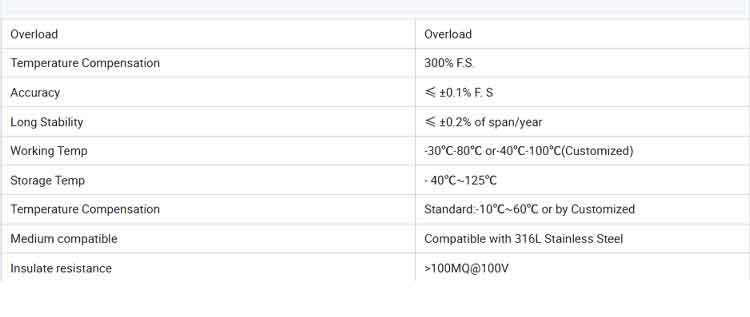
- Cannot measure high-temperature media exceeding 125°C
- The density of the measured medium must be uniform