A level sensor is a device used to accurately measure the height of liquids, widely applied in industrial automation, environmental monitoring, household appliances, and other fields. By detecting water level changes in real-time, it provides intelligent early warnings and control functions, making it a core tool in modern water management systems. Below, I will introduce its working principles, types, smart features, and application advantages step by step to help you gain a comprehensive understanding.
1. Working Principle
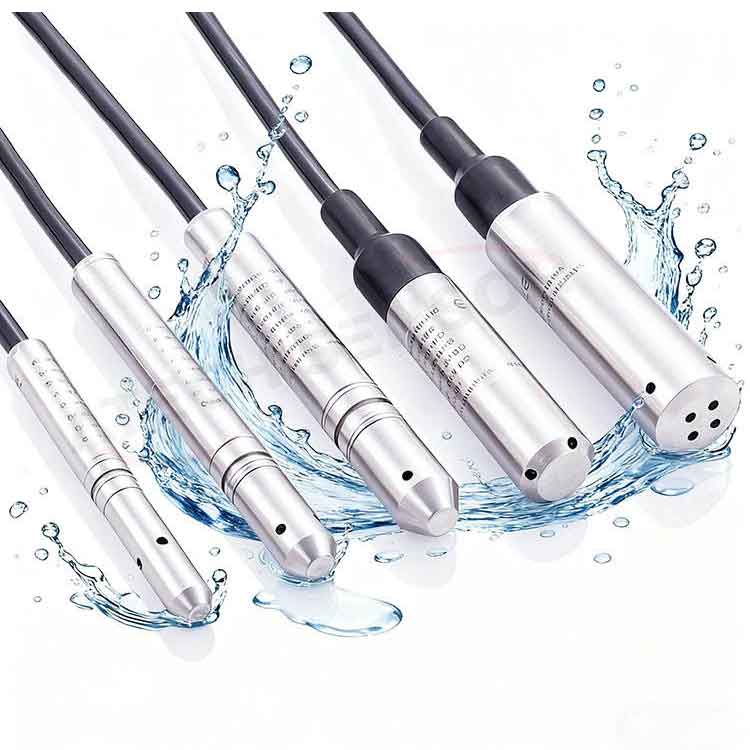
Liquid level sensors operate based on physical principles, with common methods including pressure measurement or capacitance change. The sensor calculates the water level by detecting pressure changes, and the formula can be expressed as:h = P / (ρ * g)
When the liquid height changes, the sensor outputs an electrical signal, which is then converted into digital data for system processing.
• Float type: Uses a float ball that moves with the water level, triggering a signal via mechanical or magnetic switches. Simple, reliable, and low cost, suitable for domestic water tanks.
• Capacitive type: Based on changes in the liquid's dielectric constant. The capacitance value formula is C = εA/d, where C is the capacitance, ε is the dielectric constant, A is the electrode plate area, and d is the distance. The water level change alters the capacitance, enabling non-contact measurement.
• Ultrasonic type: Emits ultrasonic pulses and calculates the distance by measuring the echo time. The formula is d = (v·t)/2, where d is the distance, v is the speed of sound (approximately 340 m/s), and t is the time. Suitable for corrosive or high-temperature liquids.
• Pressure type: As mentioned earlier, it directly measures via pressure-sensitive elements. It has high accuracy and is commonly used in industrial process control.
2.Intelligent Monitoring Features
As a "smart tool", modern level sensors integrate microprocessors and IoT (Internet of Things) technology:
• Real-time Data Processing: The sensor's built-in chip filters and calibrates collected signals to reduce noise impact. For example, algorithms are used to optimize output, ensuring stability.
• Wireless Transmission & Remote Monitoring: Connected to mobile phones or cloud platforms via Wi-Fi or Bluetooth, users can check water level data at any time and set threshold alarms (e.g., automatic notification when the water level exceeds h_max).
• Adaptive Control: Combined with AI algorithms, the sensor can predict trends (e.g., modeling h(t) based on historical data) and automatically link with pump/valve systems to adjust water levels, preventing overflow or dry-out.
• Low-power Design: Utilizing energy-saving modes, the battery life can last for several years, making it suitable for field or unattended scenarios.
3.Application Scenarios and Advantages
Level sensors play a critical role in various fields:
• Industrial Applications: Such as monitoring chemical storage tanks, ensuring safe liquid levels, and preventing leakage incidents.
• Environmental Monitoring: Used for water level warnings in reservoirs or rivers, aiding flood control management.
• Household Devices: Integrated into smart water meters or water purifiers, enabling automatic water replenishment or fault detection.
Summary of Advantages:
• High Accuracy and Reliability: Minimal measurement error and stable long-term operation.
• Cost-Effectiveness: Reduces manual inspections and improves operational efficiency.
• Intelligent Features: Facilitates "unmanned" management through data analysis and remote control.
In summary, with their real-time and intelligent monitoring capabilities, level sensors serve as powerful tools for water level management.