Ultrasonic level sensors are widely used in water wells, tanks, rivers, and industrial vessels for non-contact, maintenance-free liquid level measurement. However, one limitation that every engineer and end user should understand before deployment is the blind zone - a region near the sensor face where measurement is simply not possible.
What Is the Blind Zone? The blind zone (also called the blanking distance or near-field dead zone) is the minimum distance below the face of an ultrasonic sensor within which the sensor cannot reliably detect a target surface. When an ultrasonic sensor fires a pulse, the transducer vibrates intensely for a brief period - typically several hundred microseconds. During this time, the transducer cannot simultaneously act as a receiver. Any echo that returns to the sensor while it is still "ringing" will be masked by the transmitted pulse and go undetected. In simple terms: if the liquid surface rises into the blind zone, the sensor loses its ability to measure - it may output an error, freeze at its last reading, or report a false maximum level. 1. Loss of measurement at high fill levels This is the most common practical consequence. As the liquid level in a tank or well rises toward the sensor, there comes a point where the liquid surface enters the blind zone. At that moment, the sensor can no longer detect the echo, and the measurement becomes invalid. In a storage tank, this means the system loses visibility precisely when the tank is nearly full - a critical moment for overflow prevention. 2. False readings or error outputs When a surface is within the blind zone, different sensors behave differently. Some output the last valid reading, others output a maximum or minimum default, and others flag a hardware error. Without understanding the blind zone, operators may mistake these outputs for real level data and make incorrect decisions. 3. Reduced usable measurement range The total sensing range of an ultrasonic sensor is typically specified from the sensor face to its maximum detection distance. However, the effective or usable range begins only at the end of the blind zone. A sensor with a 5 m range and a 0.3 m blind zone delivers only 4.7 m of actual measurement. In shallow vessels or wells with limited depth, this reduction can be significant. 4. Impact in fast-changing level conditions In applications where the liquid level rises quickly - such as during heavy rainfall in a drainage system or rapid filling of a process tank - the surface may pass through the blind zone before a warning can be triggered. Systems that rely on high-level alerts must account for this by setting alert thresholds well below the blind zone boundary. How to Avoid or Minimize Blind Zone Problems 1. Choose a sensor with a shorter blind zone The most direct solution is to select a sensor designed with small blind zone. For very shallow vessels or applications where the liquid regularly approaches the sensor, consider sensors with a blind zone of less than 0.1 m, or explore alternatives that have no blind areas. 2. Mount the sensor at the correct height During installation, the sensor should be positioned so that the expected maximum liquid level. 3. Use a stilling well or guide tube in turbulent conditions In open channels, rivers, or aerated tanks, surface turbulence can produce scattered echoes and amplify the effective blind zone. Installing the sensor over a stilling well - a vertical tube that dampens surface waves - improves echo quality and brings the usable measurement range closer to the sensor face. 4. Consider sensor orientation and beam angle The ultrasonic beam emitted by the sensor is not a perfectly narrow ray - it spreads out in a cone. In narrow tanks or wells, the beam may reflect off the inner wall rather than the liquid surface, especially near the bottom. Ensuring that the beam angle is appropriate for the vessel diameter, and that the sensor is mounted vertically and centrally, reduces spurious reflections and extends the effective measurement range. The blind zone is an inherent physical characteristic of ultrasonic sensing technology, not a defect. Understanding it allows engineers and operators to design measurement systems that work reliably across the full intended range. If you are unsure whether a particular sensor is suited to your installation depth or vessel geometry, contact our technical team. We can recommend the right sensor model and mounting configuration for your specific conditions.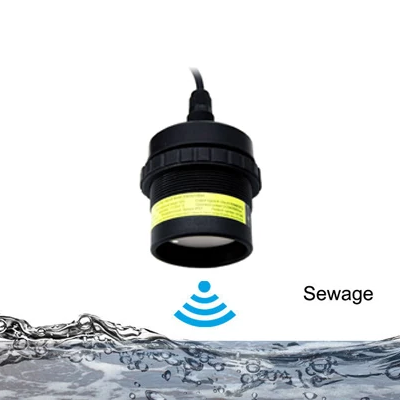
How the Blind Zone Affects Liquid Level Measurement