In industries such as water treatment, aquaculture and municipal environmental protection, pH is a core indicator for evaluating water quality. Abnormal fluctuations of water acidity and alkalinity will directly affect the treatment efficiency of sewage, the survival status of aquatic organisms in aquaculture, as well as whether sewage discharge meets regulatory standards. Traditional monitoring methods often suffer from measurement drift, poor anti‑interference capability, cumbersome installation and incapability of long‑term continuous on‑line monitoring, which can hardly satisfy practical requirements of modern automated water environment monitoring. The smart pH sensor is developed for various water quality monitoring scenarios, delivering a reliable solution for real‑time on‑line detection of water pH and temperature.
Adopting the mature and stable glass electrode method, the smart pH sensor features a detection unit composed of glass indicator electrode and reference electrode. It detects water pH value by collecting the potential difference generated by the working battery in the solution, and simultaneously measures water temperature. Equipped with automatic temperature compensation function, it effectively reduces measurement deviations caused by temperature variations. It realizes full‑range measurement from 0‑14 pH with measurement accuracy up to 0.1 pH, and temperature measurement ranges from 0‑60 ℃, suitable for most conventional water quality monitoring working conditions.
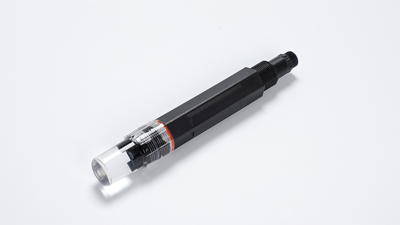
Compact in structure, the smart pH sensor is fitted with standard NPT3/4 connection thread for easy installation and deployment. It supports non‑stop on‑line water quality monitoring without shutdown for disassembly and maintenance. Built‑in dual high‑impedance differential amplifier delivers outstanding anti‑interference performance, fast response and low measurement drift. It maintains excellent measurement stability even under long‑term continuous immersion monitoring, and effectively avoids data jump caused by electromagnetic interference at industrial sites. As a digital probe, the smart pH sensor provides dual outputs of RS‑485 (Modbus/RTU protocol) and 4‑20 mA. It can be conveniently connected to various third‑party automatic control equipment including PLC, DCS, industrial control computers and recorders, and integrated into existing automation systems for centralized data acquisition and remote management.
The housing of the smart pH sensor is made of PPS material with IP68 protection rating, enabling long‑term submerged operation with pressure resistance of 0‑4 bar. It features favorable water‑resistant and anti‑corrosion properties, suitable for diverse complex installation environments such as underwater locations, pipelines and tanks. A 5‑meter signal cable is supplied as standard, and custom cable lengths are available to meet different on‑site wiring requirements and reduce project construction difficulties.
This smart pH sensor has a wide range of applicable scenarios. It can be used for monitoring domestic sewage, industrial wastewater, circulating water and surface water, and also covers aquaculture, environmental‑protection projects, cooling tower management, food and beverage production and other fields. Whether for process control in sewage treatment plants, regular monitoring of aquaculture water, supporting water‑treatment equipment or environmental‑protection discharge monitoring, it can stably output accurate data, facilitate the intelligent upgrading of water environment monitoring, and provide solid data support for water quality control, process adjustment and compliant discharge.