Pressure sensor is the most commonly used sensor in industrial practice. It is widely used in various industrial automation environments, involving water conservancy and hydropower, railway transportation, intelligent buildings, production automation, aerospace, military, petrochemical, oil well, electricity, ships, machine tools , Pipelines and many other industries. And in different environments, different types of pressure sensors need to be used to avoid errors.
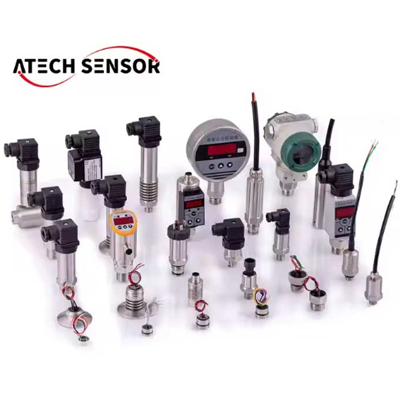
1. Piezoresistive force sensor: Resistance strain gauge is one of the main components of piezoresistive strain sensor. The working principle of the metal resistance strain gauge is the phenomenon that the resistance value of the strain resistance changes with the mechanical deformation, which is commonly known as the resistance strain effect.
2. Ceramic pressure sensor: The ceramic pressure sensor is based on the piezoresistive effect. The pressure directly acts on the front surface of the ceramic diaphragm, causing a slight deformation of the diaphragm. The thick film resistor is printed on the back of the ceramic diaphragm and connected to form a Wheatstone. The bridge, due to the piezoresistive effect of the varistor, makes the bridge generate a highly linear voltage signal proportional to the pressure and proportional to the excitation voltage. The standard signal is calibrated to 2.0/3 according to the pressure range. 0/3. 3mV/V, etc., compatible with strain gauge sensors.
3. Diffused silicon pressure sensor: The working principle of the diffused silicon pressure sensor is also based on the piezoresistive effect. Using the principle of piezoresistive effect, the pressure of the measured medium directly acts on the sensor's diaphragm (stainless steel or ceramic), causing the diaphragm to interact with the medium. The micro-displacement proportional to the pressure changes the resistance value of the sensor. The electronic circuit detects this change and converts and outputs a standard measurement signal corresponding to the pressure.
4. Sapphire pressure sensor: Utilizing the working principle of strain resistance type, using silicon-sapphire as the semiconductor sensitive element, it has unparalleled measurement characteristics. Therefore, semiconductor sensitive components made of silicon-sapphire are not sensitive to temperature changes and have good working characteristics even under high temperature conditions; sapphire has extremely strong radiation resistance characteristics; in addition, silicon-sapphire semiconductor sensitive components are not sensitive to temperature changes. p-n drift.
5. Piezoelectric pressure sensor: The piezoelectric effect is the main working principle of the piezoelectric sensor. The piezoelectric sensor cannot be used for static measurement, because the charge after the action of external force can only be saved when the circuit has an infinite input impedance . The actual situation is not like this, so this determines that the piezoelectric sensor can only measure dynamic stress.
Application areas of pressure sensors
Pressure sensors are mainly used in: booster cylinders, superchargers, gas-liquid booster cylinders, gas-liquid boosters, presses, compressors, air conditioning and refrigeration equipment and other fields.
1. Applied to hydraulic system
The pressure sensor is mainly used to complete the closed-loop control of the force in the hydraulic system. When the control spool moves suddenly, a peak pressure several times the system working pressure will be formed in a very short time. In typical mobile machinery and industrial hydraulics, if such extreme conditions are not taken into account in the design, any pressure sensor will be quickly destroyed. It is necessary to use shock-resistant pressure sensors. There are two main methods for pressure sensors to achieve shock resistance. One is to change strain-type chips, and the other is to connect an external coil. Generally, the first method is used in hydraulic systems, mainly because Easy to install. Another reason is that the pressure sensor has to withstand continuous pressure pulsation from the hydraulic pump.
2. Applied to safety control system
Pressure sensors are often used in safety control systems, and the main target area is the safety management system of the air compressor itself. There are many sensor applications in the field of safety control. As a very common sensor, pressure sensors are not surprisingly used in safety control systems.
Applications in the field of safety control are generally considered from the perspective of performance, from the consideration of price, and from the safety and convenience of actual operation. It has been proved that the effect of selecting a pressure sensor is very good. The pressure sensor uses the processing technology of mechanical equipment to install some components and signal conditioners on a small chip. So small size is also one of its advantages, in addition to its low price is another major advantage. To a certain extent, it can improve the accuracy of system testing. In the safety control system, the pressure brought by the compressor is controlled to a certain extent by installing a pressure sensor in the piping equipment of the air outlet. This can be regarded as a certain protective measure, and it is also a very effective control system. When the compressor starts normally, if the pressure value does not reach the upper limit, the controller will open the air inlet and adjust to make the equipment reach the maximum power.
3. Applied to injection mold
Pressure sensors play an important role in injection molds. The pressure sensor can be installed in the nozzle of the injection molding machine, the hot runner system, the cold runner system and the cavity of the mold. It can measure the plastic from the injection molding machine nozzle to the injection molding machine during the injection molding, filling, pressure holding and cooling process. Plastic pressure somewhere between the mold cavities.
4. Applied in monitoring mine pressure
Sensor technology is one of the key technologies for mine pressure monitoring. On the one hand, we should correctly apply the existing sensors to serve the mining industry; on the other hand, as a sensor manufacturer, we must develop and develop new pressure sensors to adapt to more mining industry applications. There are many kinds of pressure sensors, and based on the special environment of mine pressure monitoring, the main mine pressure sensors are: vibrating wire pressure sensor, semiconductor piezoresistive pressure sensor, metal strain gauge pressure sensor, differential transformer pressure sensor, etc. These sensors have a wide range of applications in the mining industry, and which sensor to use can be selected according to the specific mining environment.
5. Used to promote sleep
The pressure sensor itself cannot promote sleep. We just put the pressure sensor under the mattress. Because the pressure sensor has high sensitivity, when a person turns over, heartbeat, breathing and other related actions, the sensor will analyze this series of information to infer sleep What state is the person sleeping in, and then through the analysis of the sensor, collecting the sensor signal to get the sleep data such as heartbeat and breathing rhythm, and finally processing all the data into a piece of music, of course, it can compress your night’s sleep into one. The first few minutes of music.
6. Used in compressors, air-conditioning cold equipment
Pressure sensors are often used in air compressors, and air conditioning and refrigeration equipment. This type of sensor products are small in size and easy to install. The pressure guide port is generally designed with a special valve needle.
Trend
1. The main vertical industries, including oil and gas, automotive, and medical care, have led to the evolution of multiple applications and pressure sensor functions.
2. The automotive field is one of the most important users of pressure sensors. The surge in automotive production has led to an increasing demand for pressure sensors and related components.
3. Motor vehicle safety has become an important aspect of the entire automotive industry. Strict government regulations surrounding this feature will help promote the growth of demand for pressure sensors in the automotive industry.
4. Technologies based on micro-electro-mechanical systems (MEMS) and nano-electro-mechanical systems (NEMS) have always been widely welcomed by the public, and their adoption has increased greatly, leading to the growth of the pressure sensor market.
5. The consumption of consumer electronic pressure sensors has greatly increased, becoming the fastest growing application field in the entire market.
6. The maturity of end-use industries such as automotive and healthcare markets has become a major challenge hindering the pressure sensor market in North America and Europe.
7. The rapid industrialization and motor vehicle production in Asian countries such as China, Japan, India and South Korea can be attributed to the development of the Asia-Pacific pressure sensor market.
8. The development of smart city infrastructure in the Asia-Pacific and Middle East regions holds huge potential for future growth.
9. Consumers buying pressure sensors are worried about the soaring cost of installation and replacement, which may affect the pressure sensor market.
10. In the past few years, the pressure sensor market has made rapid progress, which has had a positive impact on the competitive landscape, introducing new participants to the market and expanding the scope of existing participants in the market.