In fields such as industrial monitoring, meteorological observation, and new energy development, the precise collection of wind speed data is a critical component for ensuring safety and enhancing efficiency. The wind speed sensor, with its affordable price, exceptional performance, and broad compatibility, breaks the market pain point of "high quality must mean high cost," making it a cost-effective choice. Its extensive application prospects further help various industries achieve low-cost, high-precision upgrades in wind speed monitoring.
As a high-performance, value-focused sensor, the wind speed sensor makes no compromises on core capabilities. Utilizing a non-contact magnetic sensing measurement principle, it ensures measurement accuracy ranks among the industry's best—with an error of only ±0.5 m/s at wind speeds <5 m/s and within ±3% FS at wind speeds ≥5 m/s. Its starting wind speed is as low as 0.5 m/s, enabling precise capture of data across the full range from gentle breezes to strong winds. Constructed from high-precision aluminum alloy with a polyester coating, it boasts a wind resistance exceeding 70 m/s (30 min) and an IP65 protection rating, allowing it to withstand harsh environments such as rain, snow, salt spray, and dust. Its wide operating temperature range of -20°C to +85°C and humidity adaptability of 0%–95% (non-condensing) ensure stable performance in complex scenarios like high-altitude regions, coastal areas, and outdoor construction sites.
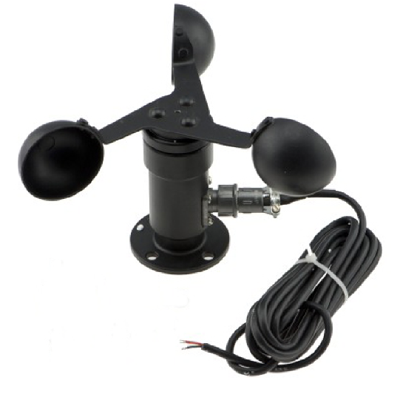
Even more commendable is that the wind speed sensor maximizes its price advantage while maintaining quality, significantly reducing procurement costs for small and medium-sized enterprises and engineering projects. Its circuit features fault-tolerant design combined with multi-level lightning and surge protection. The standard version meets CE EMC standards, while the lightning-resistant version can withstand surges up to 4000V, extending service life and reducing later maintenance costs. With multiple output signal types, including 4–20 mA, 0–10 VDC, pulse, and RS485, it can integrate seamlessly into existing systems without requiring additional adaptation equipment. Its simple installation and strong compatibility further reduce deployment costs, truly achieving "low-cost investment, high-quality output."
Broad application scenarios open up significant market potential for this wind speed sensor. In high-altitude operations and construction machinery, it provides real-time wind speed warnings for tower cranes and aerial work platforms, ensuring construction safety. In weather stations and environmental monitoring, it delivers accurate data to support climate analysis and pollution dispersion studies. For wind turbines, port machinery, and other equipment, it offers a scientific basis for startup, shutdown, and operational adjustments. It also covers various industrial production scenarios where wind speed-related safety management is required. As the new energy industry grows, infrastructure construction accelerates, and safety production regulations tighten, the demand for wind speed monitoring is expanding from traditional fields to emerging industries and from large enterprises to small and medium-sized businesses. The wind speed sensor, with its high cost-effectiveness, precisely meets market needs and has become an essential choice for wind speed monitoring across sectors.
Combining affordability, robust performance, and a vast range of applications, the wind speed sensor is not only an optimal solution for current cost control but also helps users seize industry development opportunities. Choosing this sensor requires no high investment, yet it delivers stable and reliable wind speed monitoring capabilities. It enables users to gain a competitive edge amid growing market demand, achieving both cost reduction and efficiency improvement alongside business upgrades.