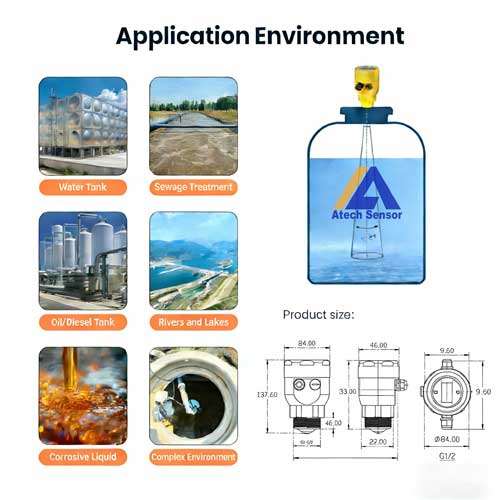
Radar level gauges play an important role in fields such as industrial automation, environmental monitoring, and water conservancy projects. They can accurately measure the real-time height of liquids, providing accurate data support for process control in production, collection of environmental data, and water resource management.
I.Working Principle: Precision Measurement Based on "Echo"
The core principle of a radar level transmitter is the Time of Flight (ToF) method, and its working process can be simplified into three steps:
- Transmission: The instrument's antenna emits high-frequency microwave pulses (common frequencies are 6GHz, 26GHz or 80GHz) toward the surface of the medium inside the vessel.
- Reflection: When microwave pulses hit the surface of a medium (e.g., liquid), part of the energy is reflected back due to the difference in dielectric constant between the medium and air.
- Reception and Calculation: The instrument's receiver captures the reflected wave and accurately measures the time difference (Δt) between the transmitted wave and the reflected wave. Since the propagation speed of electromagnetic waves in air (c) is equal to the speed of light (approximately 3×10⁸ m/s), the distance (D) from the instrument's probe to the medium surface can be calculated using the formula: D = c × Δt / 2. Combined with the known total height of the vessel (E), the final liquid level height is derived as L = E - D.
Ⅱ.Main Types and Technological Evolution:
Based on antenna structures and signal processing methods, radar level transmitters are mainly divided into two categories:
- Non-Contact Radar:The antenna is mounted on the top of the vessel, with radar waves propagating and reflecting in the air. It is suitable for applications with high hygiene and anti-corrosion requirements, such as the food and pharmaceutical industries.
- Guided Wave Radar (GWR): It adopts metal probe rods or cables as waveguides to direct microwave energy to the medium surface. Boasting stronger signals and superior anti-interference capability, it is particularly suitable for measuring media with low dielectric constants (e.g., liquefied gas, light oil) or working conditions with agitation and foaming.
In recent years, the technologies of have developed rapidly. With a narrower beam angle, they can accurately avoid obstacles on the inner vess 80GHZ and 120GHZ high-frequency radarsel walls (e.g., agitators, heating coils) and realize more reliable measurements in complex tank structures.
III. Installation Precautions:
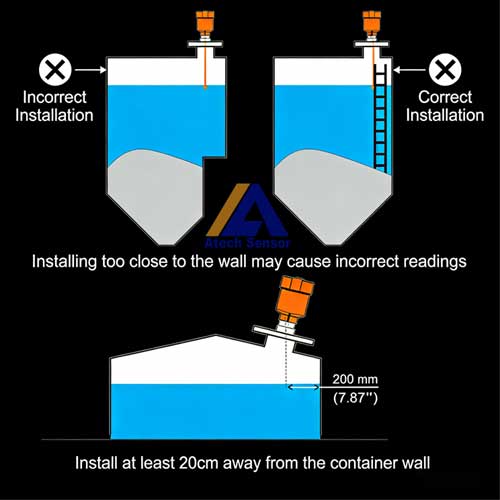
- Mounting Position: Install at a distance of more than 200 mm from the vessel wall with an included angle of ≤5° to the wall, ensuring the signal is transmitted directly to the measured medium surface. Meanwhile, keep away from interference sources such as feed inlets and agitators.
- Mounting Base: Strict requirements are imposed on the stability of the mounting base, with the strength of the tank roof being the primary consideration. Insufficient roof strength may cause a deviation in the radar wave emission angle and compromise measurement accuracy.
- Measuring Range: The measuring range is calculated from the point where the beam touches the tank bottom. If the tank bottom is concave or conical, measurement is not possible when the level falls below this point. Theoretically, measurement up to the antenna tip is feasible, but considering the impacts of corrosion and adhesion, the end value of the measuring range should be at least 100 mm from the antenna tip.
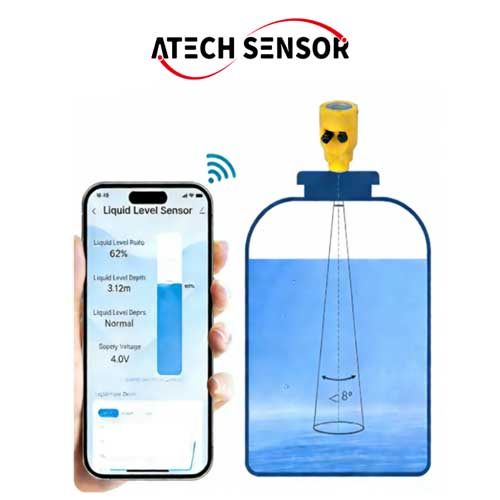
- Antenna Design: Select a horn antenna with a beam angle of ≤8° to avoid multipath reflection in small-diameter storage tanks; antennas with a self-cleaning coating can reduce the adhesion of viscous media.
IV. Application Scenarios Include:
- Liquid level monitoring of crude oil and refined oil in petrochemical storage tanks.
- Liquid level control of clear water tanks and sedimentation tanks in water treatment plants.
- Level measurement of desulfurization slurry tanks and ash slag tanks in the power industry.
- Liquid level management of fermentation tanks and batching tanks in the food and beverage industry.